

.png)
.png)
.png)
.png)
Somebody enters their PIN wrong three times. The card stops accepting it. They call the bank, the bank sorts it out, and a day later the card works again. Nobody involved thinks any more about it.
But stop and ask what actually happened. The rule that blocked the card lives on the chip. The counter that reached its limit lives on the chip. Nothing the bank does to its own database can touch either of them. So how did the chip find out?
Cards are not finished when they are issued
Here is the part most people outside card issuing never learn: a payment card is not a fixed object. The chip accepts commands after issuance. Its parameters can be changed, its counters reset, its application blocked or unblocked, its PIN replaced.
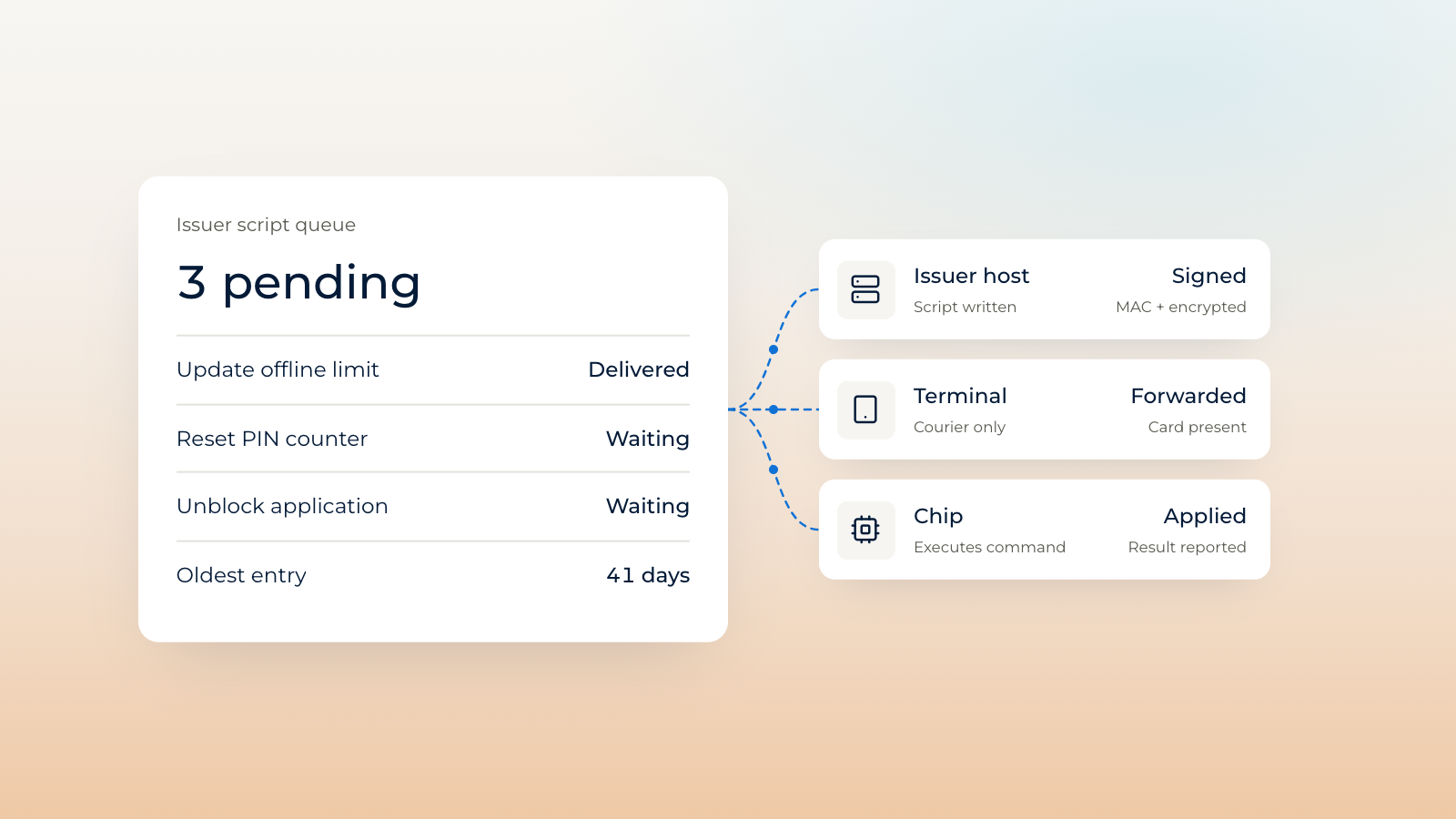
The industry calls these issuer scripts — instructions written by the issuer, addressed to one specific card, carried out by the chip itself. They can block or unblock an application, block the whole card, change or unblock the PIN, or write new values into the card’s data. That last one is the quiet workhorse: risk parameters, offline spending limits, and the counters that govern how much a card is trusted without checking in.
The card is not a snapshot of what the issuer decided at personalization. It is a device the issuer can keep editing.
But only when the card shows up
There is no separate channel. No over-the-air update, no background sync. A script reaches a card one way only: attached to the response to an authorization request, handed to the chip by the terminal while the card is still present.
Every part of that has to happen. The card has to be used. It has to go online rather than being approved locally. The terminal has to support scripts. And all of it has to occur in the couple of seconds the card is in contact. Miss any of those and the instruction simply waits.
Which is why the queue exists
An issuer who tightens a risk parameter across a portfolio does not get to apply that change. They get to make it available, and then wait. Cards used frequently, where transactions go online, pick it up quickly. Cards used mostly for small, locally approved amounts may not go online for weeks. A card in a drawer never picks it up at all.
The result is a portfolio running several configurations at once, all of which the issuer believes it has updated. A parameter change in card issuing is not an event. It is a distribution problem with a very long tail — and the length of that tail is set by cardholder behavior, not by the issuer.
Can anyone send these?
No, and the way that is prevented is the same pattern that shows up everywhere in payment security. Scripts are protected by secure messaging, using two separate keys derived from the issuer’s master keys.
- Integrity: the script carries a code proving it came from the issuer and was not altered. A script that fails this check is refused by the card.
- Confidentiality: when a script carries something that must not be readable in transit — a new PIN is the obvious case — that value is encrypted so only the card can recover it.
Integrity alone would let anyone in the path read a new PIN. Confidentiality alone would let someone substitute a valid-looking command. Together, the terminal becomes a courier forwarding a sealed envelope it cannot open and cannot forge. It parses out the commands, passes them to the chip in order, and reports back. Issuers are even free to use proprietary commands the terminal has never heard of.
When it does not work
Scripts fail, and they fail quietly. The card may reject a command that fails the integrity check. The cardholder may pull the card early. The transaction may end before the script runs. A terminal may not support script processing at all.
The terminal reports the outcome, so the issuer can know whether an instruction landed. Whether anyone reads those reports is another question. There is also timing: scripts run either before or after the card produces its final cryptogram. A command that changes something the card is about to use must arrive first; one that would disrupt the transaction must wait. Getting that wrong does not produce an error. It produces a transaction that behaves oddly once and is never reproduced.
Three questions for every issuer
- What is in your script queue right now, and how old is the oldest entry? Months-old instructions are not a backlog — they are a slice of your portfolio running configurations you believe you retired.
- Do you read the results? A delivery mechanism with no confirmation is no delivery mechanism for anything that matters.
- What proportion of your traffic goes online at all? That number is the ceiling on how fast any card-level change can propagate. For card issuing, it is the speed limit.
The bigger point
We tend to think of a card as a thing that gets issued, used, and eventually replaced. It is closer to a small device with an intermittent network connection, reachable only when its owner happens to use it, running whatever configuration last got through. Everything an issuer wants to change has to queue up and wait for a moment of contact.
How PayCloud helps
Our EMV Testing and Certification tools validate script processing across ISO 7816 and ISO 14443 before a portfolio goes live — so issuers know which changes will arrive, and when.




.svg)