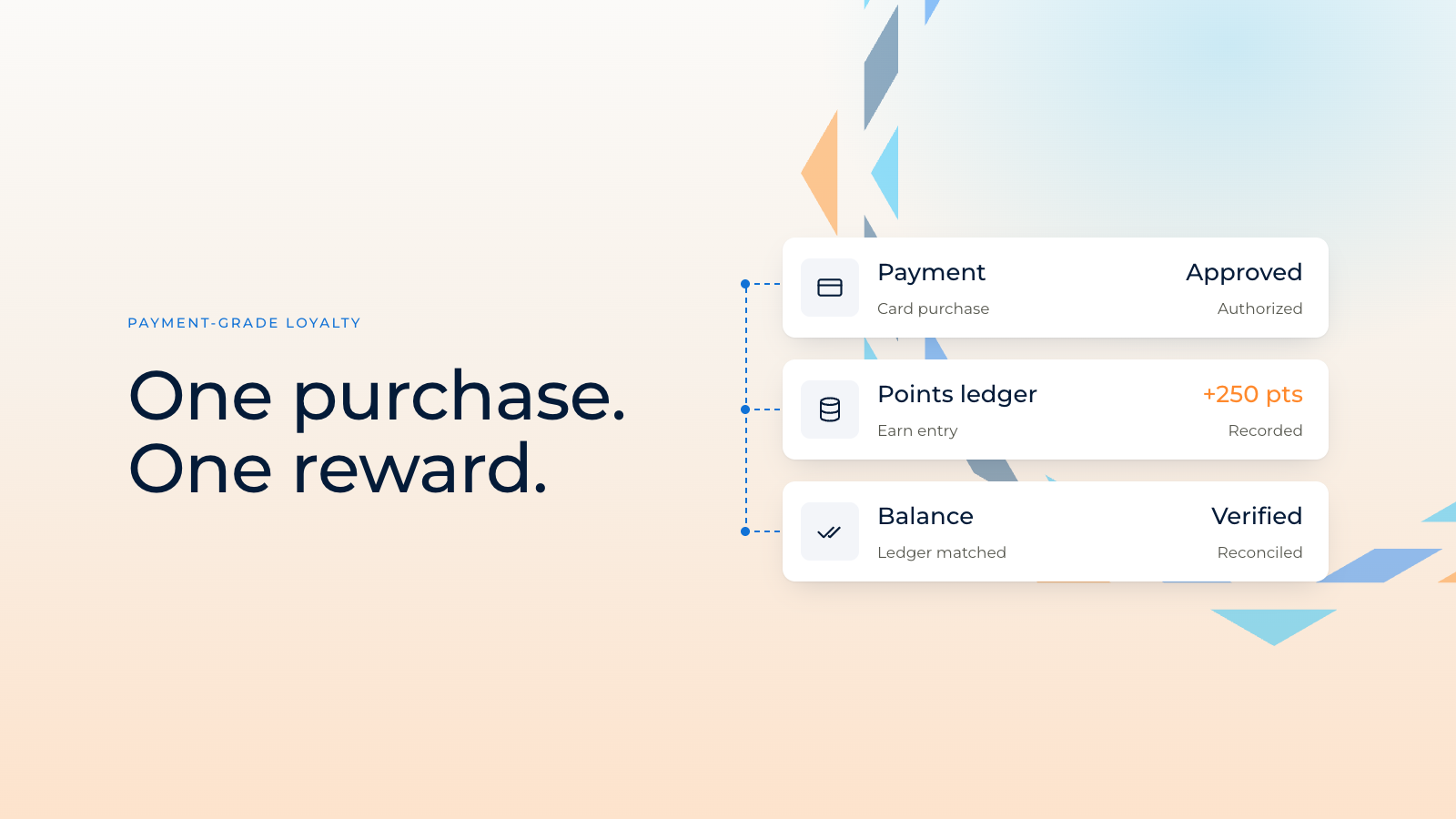
Because every point a program issues is value the business owes. A payment system records each movement of money once, keeps a ledger that proves every balance, and reconciles its books daily. A loyalty program built the same way rewards each purchase exactly once, can explain any balance, and gives finance a figure it can trust.
Why does a points balance need to be as accurate as a bank balance?
Because finance teams carry outstanding points on the balance sheet, and a balance that drifts becomes a reporting problem rather than a marketing one.
A loyalty program is usually described in marketing terms: enrollment, engagement, redemption rates. Underneath, it is a promise. Every point a cardholder holds is a claim on a future discount, a free coffee, or a room night, and the business has to honor it whenever the cardholder decides to spend it.
That makes a points balance closer to a bank balance than to a website metric. A cardholder who checks their balance expects the number to be right. So does the finance team, which has to report what the business owes. Payment systems were built from the start for exactly that standard. Loyalty programs often were not, because for years they were treated as a promotion rather than an obligation.
What is the difference between a points balance and a points ledger?
A balance is a single number. A ledger is the complete record of every movement that produced it.
A system that stores only a balance updates one figure each time something happens: points added for a purchase, subtracted for a redemption, adjusted after a complaint. Once the figure changes, the history behind it is gone. If a cardholder disputes their balance, or the total stops matching sales, there is nothing to work backward from.
A ledger, the running record of every transaction, keeps each earn, redemption, reversal, and expiry as its own entry and never overwrites one. The balance is calculated from those entries rather than stored on its own, so any balance on any date can be reproduced and explained.
Payment-grade ledgers go one step further with double entry, the bookkeeping method in which every movement is recorded twice: once where the value leaves and once where it lands. Points issued to a cardholder are matched by the obligation the program now carries. Because both sides must always agree, an entry that is missing or recorded twice shows up as an imbalance instead of hiding inside a total.
How do loyalty systems prevent duplicate rewards?
By making every reward request idempotent, meaning a request repeated any number of times has the effect of being processed once.
Duplicates are not caused by faulty equipment. A terminal that sends a purchase and hears nothing back cannot tell whether its message was lost or only the reply was, so it sends the purchase again. Muskan Yadav, a software engineer at PayCloud Innovations, makes the point directly in his article on the subject: “A retry is not a mistake.” The real question is what the loyalty system does when the same purchase arrives twice.
The standard answer is an idempotency key, a unique label attached to each purchase. The first time the loyalty system sees a key, it awards the points and stores the result. Any later request carrying the same key receives that stored result, and nothing new is written.
Two details decide whether this works in practice. The key has to be built from the purchase itself, such as the terminal and the transaction reference, because a key generated fresh on each attempt makes every retry look new. And the check for an existing key and the write of a new one have to happen as a single step, or two copies arriving at the same instant can both be rewarded.
Redemption raises the stakes. A retried earn gives points away. A retried redemption can deduct a balance twice or issue two rewards against one, and a retried refund can reverse the same purchase twice. Every movement of value, in either direction, needs the same protection.
How are loyalty points treated in accounting?
Under the main revenue standards, points that give a customer a meaningful future discount are generally treated as a liability until they are redeemed or expire.
In the United States the governing standard is Accounting Standards Codification (ASC) Topic 606, and internationally it is International Financial Reporting Standard (IFRS) 15. Both treat a loyalty point as a separate promise to the customer when it provides what the standards call a material right: a benefit the customer would not receive without making the purchase. When that applies, part of the price of the original sale is set aside for the points, based on the relative standalone selling prices of the goods and the points, and held as a liability, often called deferred revenue or a contract liability. That portion becomes revenue when the points are redeemed or expire.
Breakage, the share of points a business expects will never be redeemed, is recognized as revenue in step with how the remaining points are redeemed, which depends on a reliable estimate. Whether a particular program creates a material right, and how its points are valued, is a judgment each business makes with its auditors. This article describes the general framework and is not accounting advice.
The engineering consequence is simple. The loyalty system’s records feed a figure on the balance sheet. A duplicate earn inflates that figure, and a balance that cannot be traced is harder to defend. Accuracy in the loyalty platform is what lets finance report the liability with confidence.
What does payment-grade loyalty look like in practice?
The loyalty program adopts the habits payment systems already have: every transaction has an identity, every movement is recorded, and the books reconcile on a schedule.
Payment Switch, PayCloud’s issuing switch, is the engine that routes each card transaction by card range and reconciles settlement at the end of each day. It is configuration-driven and routes at the BIN level, meaning by the Bank Identification Number, the leading digits of a card number that identify the issuer. That last habit, confirming every day that what was recorded matches what actually moved, is the one loyalty programs most often skip.
Loyalty Exchange applies the same habit to points. It runs a double-entry points ledger, so every point issued, redeemed, reversed, or expired is recorded on both sides, and every balance can be traced to the purchases that built it. Because the program runs on the same platform as the payment, card-linked loyalty credits points from the same transaction the cardholder has already made. Loyalty rides inside the payment, with nothing extra to present at the counter.
What should a loyalty program owner check first?
Whether the program pays out once per purchase, and whether its liability reconciles to the figure finance reports.
Muskan’s test is the quickest place to start. Send the same purchase twice, a few seconds apart. Send it twice at exactly the same moment. Send it again an hour later. If the balance moves once in every case, the program is keeping its promise. If it moves more than once in any of them, the program is paying for purchases that happened once.
Then ask three questions of the platform. Can it reproduce any cardholder’s balance on any past date, entry by entry? How often is the total of points outstanding reconciled against the liability finance reports, and who signs off? And when marketing changes an earn rate or runs a bonus-points promotion, does finance see the effect on the liability before it launches, or after?
None of these questions needs a new program to answer. They need a ledger, a reconciliation habit, and a shared understanding that loyalty points are a financial commitment as well as a marketing one.
Where to go next
Loyalty Exchange and Payment Switch are part of PayCloud Provision™, built on Provision-Once Architecture™. A credential is provisioned once and managed through every change that follows, across payments, access, identity, and loyalty.
Provision. The credential is placed securely in the cardholder’s iPhone, Apple Watch, or Android phone, ready for the first tap. Manage. Updates, renewals, and pauses run from one platform, keeping credentials current without starting over. Trust. Every credential stays protected by one security approach, so cardholders and guests tap with confidence.
Related: How do hotels put room keys in Apple Wallet and Google Wallet?
Provisioned once. Trusted everywhere. One secure infrastructure for payments, access, identity, and loyalty.
Frequently asked questions
What is the difference between a points balance and a points ledger?
A balance is one number that is updated each time points move. A ledger records every earn, redemption, reversal, and expiry as a separate entry and calculates the balance from them, so any balance on any date can be reproduced and explained.
What is idempotency in a loyalty program?
Idempotency means a request can be repeated any number of times with the effect of processing it once. In loyalty, it ensures a purchase that a terminal sends twice, because the first reply was lost, earns points only once.
How do loyalty systems prevent duplicate rewards?
Most attach an idempotency key, a unique label built from the purchase itself, to each request. The first request with a key is processed and its result stored. Later requests with the same key receive the stored result, and nothing new is written.
How are loyalty points treated in accounting?
Under ASC 606 and IFRS 15, points that give a customer a material right are generally a separate obligation. Part of the sale price is allocated to them and held as a liability until the points are redeemed or expire. Each business confirms its own treatment with its auditors.
What is breakage in a loyalty program?
Breakage is the share of points a business expects will never be redeemed. Under the revenue standards it is recognized as revenue in proportion to how the remaining points are redeemed, based on a reliable estimate.
Sources
BDO USA. ASC 606’s Impact on Loyalty Programs: Redemption is Key (accessed November 2026).