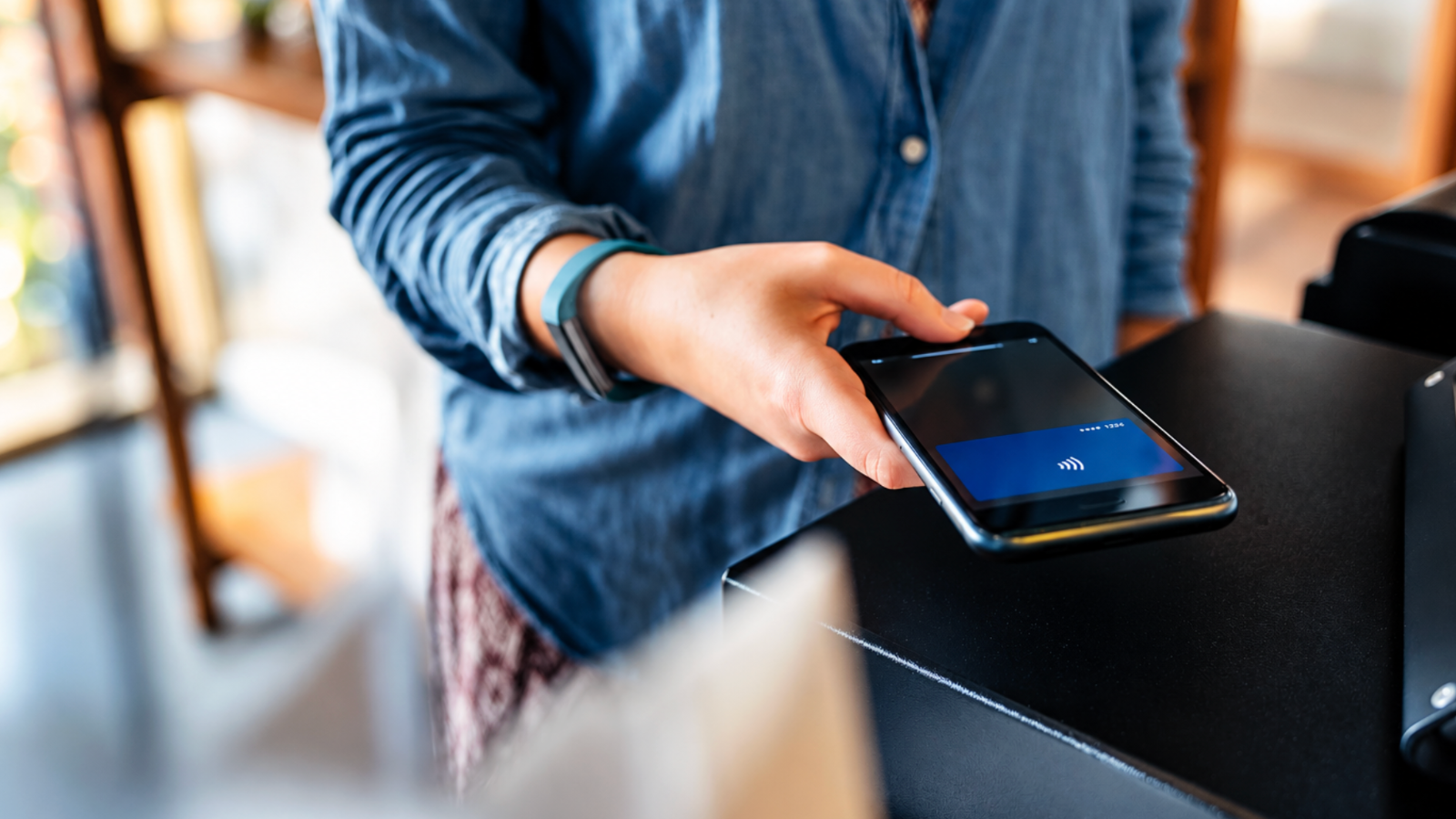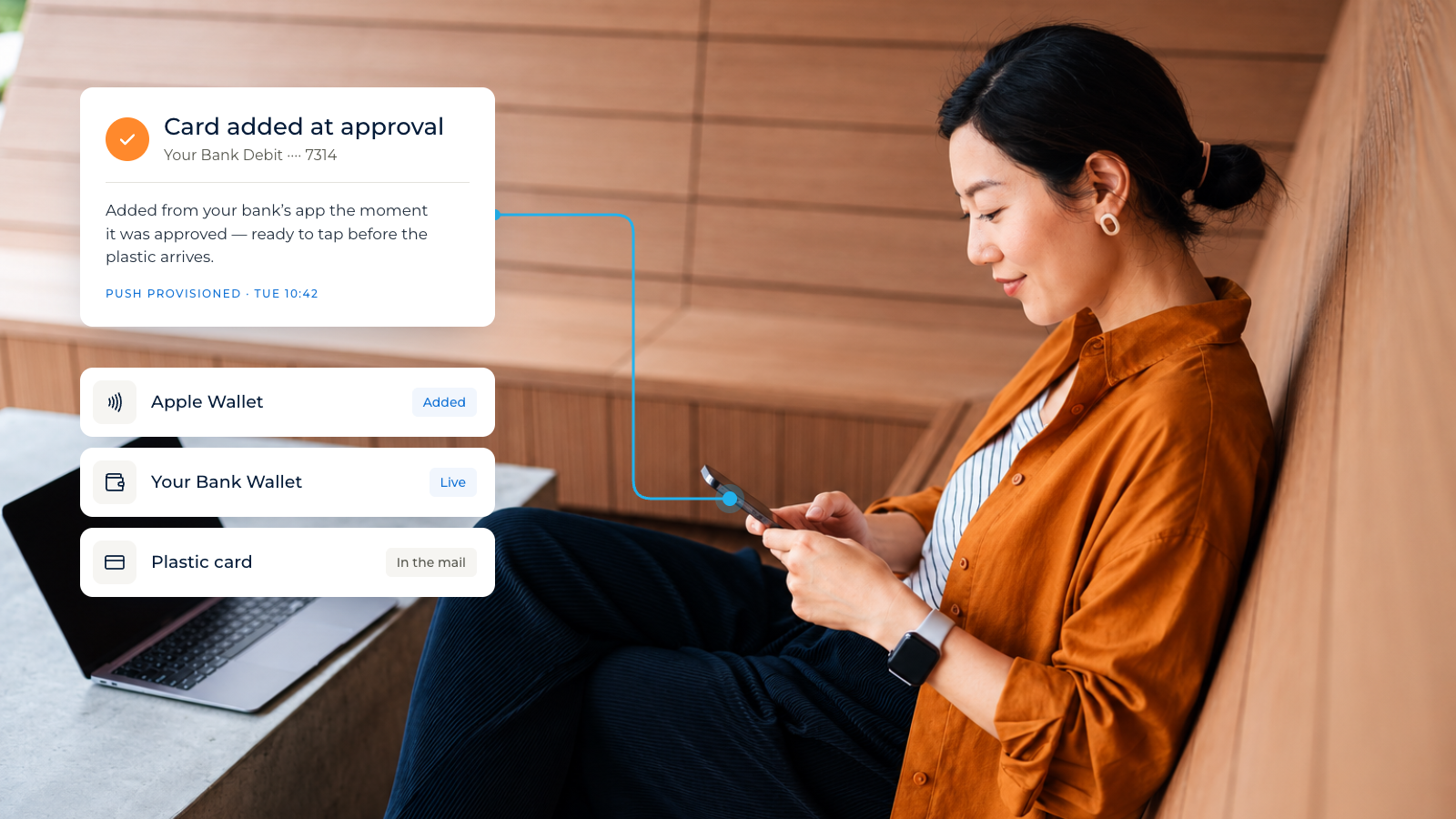
A bank puts its card in a customer’s phone at approval through push provisioning, which lets the cardholder add the card to Apple Wallet or Google Wallet directly from the bank’s own app. The card works before the plastic arrives, and the bank chooses the moment it happens.
What is push provisioning?
Push provisioning is adding a card to a digital wallet directly from the issuer’s own app, instead of asking the cardholder to type a card number into the wallet themselves.
Both platforms support it, and both describe it in their own documentation. Google’s issuer documentation states that cards can be added to Google Pay either through the Google Wallet app or through an issuer’s mobile banking app using its push provisioning API. Apple’s PassKit documentation describes in-app provisioning as relying on the person to add a payment pass from within the issuer app, with the intention of adding it.
The difference between that and manual entry is not convenience. It is control. In manual entry, the cardholder has to find the card, type sixteen digits correctly, and complete verification on their own initiative. Every one of those steps is a place the process stops. In push provisioning, the bank presents the option at a moment of its own choosing, and the card data moves between systems rather than through a keyboard.
One step in the middle deserves naming, because it is where push provisioning either feels effortless or does not. Before a card is provisioned, the issuer has to satisfy itself that the person adding it is the cardholder. Doing that inside your own app, where the customer has already authenticated, is far less friction than sending a one-time code and hoping it arrives and is read. That verification decision is largely yours rather than the platform’s, and it does more to determine completion rates than the button placement does.
Why does the moment of approval matter?
Approval is the only point at which a new card has the cardholder’s full attention, and that attention does not wait for the mail.
Think about what the alternative looks like. A customer is approved on Tuesday. The plastic arrives the following week. In between, they have a working phone, a wallet already holding another institution’s card, and no reason to think about yours. By the time the envelope arrives, the habit of reaching for a different card has had a week to set.
The card that is present when someone wants to buy something is the card they use. Approval day is when your card can be present. That is the entire argument, and it does not require a forecast to believe.
It also changes what your support team deals with later. A cardholder who added the card themselves, in your app, with your branding around the moment, knows where the card came from. That is not a small thing when they later call about a charge.
Can a bank offer its own wallet next to Apple Pay and Google Wallet?
Yes, and the honest answer is that the two do different jobs rather than competing for the same one.
Push provisioning puts your card into the wallet your customer already uses every day. A branded wallet is a surface your institution owns, where your name is on the screen and you decide what sits next to the card. Most institutions eventually want both, and the mistake is treating the choice as either one or the other.
It is worth knowing that Google’s own best-practice documentation for issuers observes that many of them adopt push provisioning specifically to reduce the operational work of running their own wallet. That is a fair point and we would rather you hear it from us than discover it later. Running a wallet is real work with real ongoing cost.
Which is why the question to ask is not whether a branded wallet is good, but what you need to put in front of a customer that will not fit inside a payment card. If the answer is nothing, push provisioning on its own may serve you well. If the answer includes loyalty balances, spending controls the cardholder sets, an access credential, or an identity the customer presents, those need somewhere to live, and the phone’s default wallet is not built to be your product.
What does a branded wallet actually hold?
More than a card, which is the only durable reason to build one.
White Label Wallet gives banks, retailers, and hotels a digital wallet under their own brand that holds payments, access, identity, and loyalty together. The card is the anchor, and the value comes from what the institution can place beside it: rewards that post at the moment of payment, controls a cardholder can set, a credential that opens something, proof of who someone is.
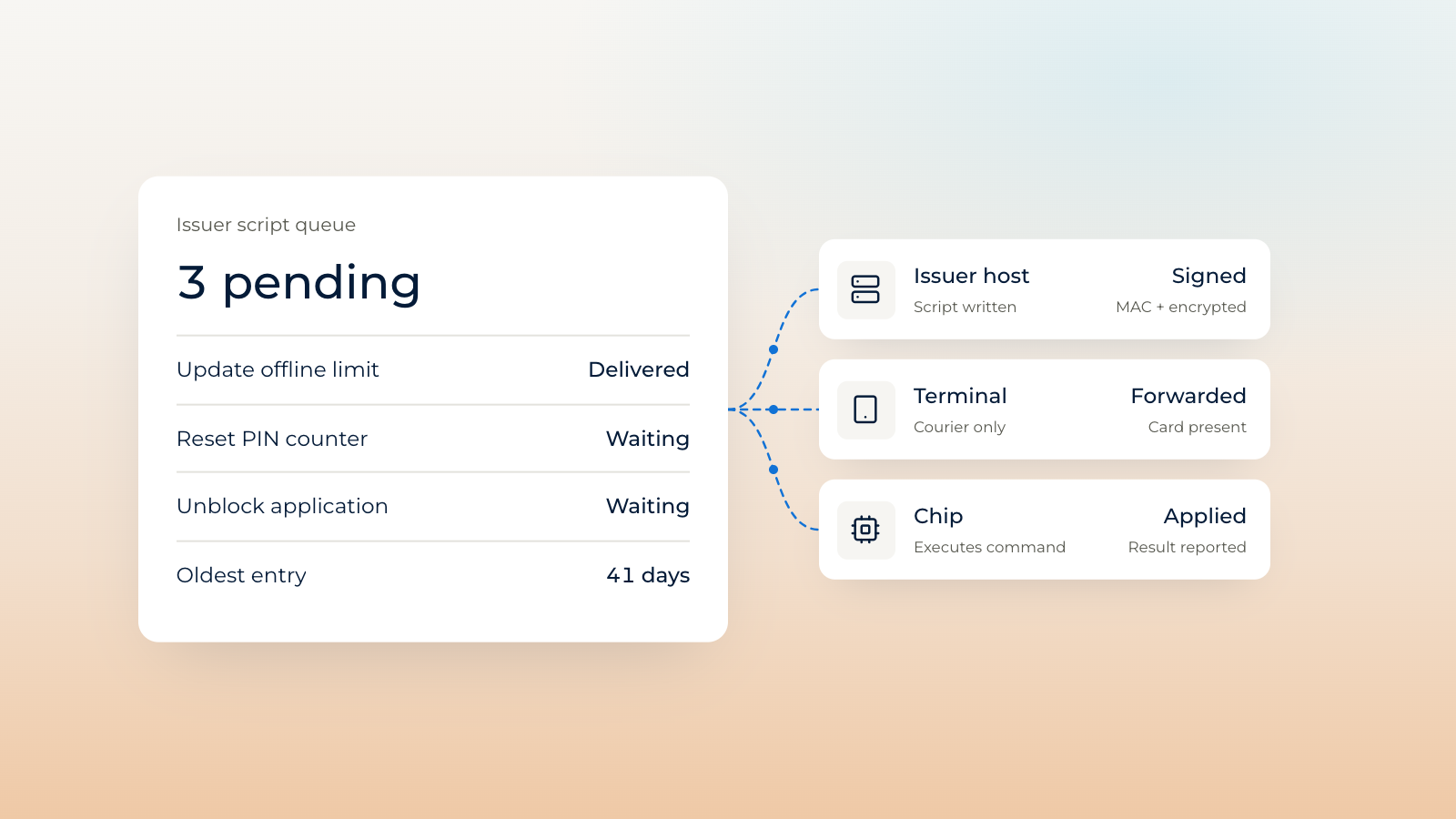
Underneath, the provisioning routes are the same ones any credential takes. Apple SE TSM places credentials in the secure element, the tamper-resistant chip inside iPhone and Apple Watch. Android HCE uses host card emulation, the method Android uses to let a phone act as a contactless card, to deliver the same experience on Android devices. The cardholder should never need to know which of those happened.
There is a second reason to build one, and it is worth stating plainly because it is often the real one. In a default wallet, your card is a rectangle among other rectangles, and the brand surrounding the moment of payment belongs to someone else. That can be a perfectly acceptable trade. It is a trade, though, and institutions are better served making it deliberately than arriving at it by never having discussed it.
How long does a branded wallet take to launch?
Six to twelve months from planning to launch is the realistic range for a first branded wallet.
That is a wide range on purpose, because the things that move it are knowable in advance and worth naming.
Scope moves it most. A wallet holding one payment credential is a different project from one holding payment, loyalty, and an access credential, and the difference is not proportional. Certification calendars move it next, and they are set by parties outside your organization, so they cannot be compressed by adding people. Internal approvals move it third, and they are usually the item teams underestimate, because the security and compliance review of a customer-facing wallet is not the same review a back-office system gets.
What does not move it much is engineering effort on the provisioning itself. That part is well understood. Teams that finish near the short end of the range are usually the ones that scoped narrowly and started their certification conversations early, not the ones that staffed the build more heavily.
What should a bank decide first?
Decide what goes in the wallet besides the card, because that single answer sets the scope, the timeline, and whether a branded wallet is the right call at all.
Everything else follows from it. A team that can answer that question in one sentence can be given a useful estimate. A team that cannot is not ready for one, and an estimate given anyway will be wrong in a direction nobody enjoys.
Where to go next
White Label Wallet is part of PayCloud Provision™, built on Provision-Once Architecture™. A credential is provisioned once and managed through every change that follows, across payments, access, identity, and loyalty.
Related: What happens to a mobile credential after it is provisioned?
Provisioned once. Trusted everywhere. One secure infrastructure for payments, access, identity, and loyalty.
Frequently asked questions
What is push provisioning?
Push provisioning is adding a card to a digital wallet directly from the issuer’s own app, rather than having the cardholder manually enter the card number into the wallet. Both Apple and Google provide issuer documentation and APIs for it.
Can a bank offer its own branded wallet alongside Apple Pay and Google Wallet?
Yes. They do different jobs. Push provisioning places your card in the wallet a customer already uses, while a branded wallet is a surface the institution owns and can place loyalty, controls, access, or identity beside the card. Most institutions want both.
How long does a branded wallet take to launch?
Six to twelve months from planning to launch is a realistic range for a first branded wallet. Scope, certification calendars, and internal security and compliance approvals move the timeline more than engineering effort does.
What is a white label mobile wallet for banks?
A white label mobile wallet is a digital wallet that carries the bank’s own brand while the provisioning and key management infrastructure runs underneath it. PayCloud’s White Label Wallet holds payments, access, identity, and loyalty in one place under the institution’s name.
Does a card added at approval work before the physical card arrives?
Yes. A card provisioned into a phone at the moment of approval can be used immediately, which is the central reason issuers push provision at approval rather than waiting for the plastic to be delivered.
Sources
Apple Developer. Implementing Wallet Extensions, PassKit documentation (accessed October 2026).
Google for Developers. Google Pay flows, Device Tokenization Developer Site (accessed October 2026).